01 / The company & its cars

GWK: a small car with a big idea.

Three engineers made changing speed remarkably simple. Turning their invention into a lasting motor business proved much harder. This is the story told by the cars, the contemporary press and the people who knew them.

From Beckenham to Datchet and Maidenhead · 1910–1931 · The story continues with the surviving cars

1910–1911

Three engineers and a different way forward
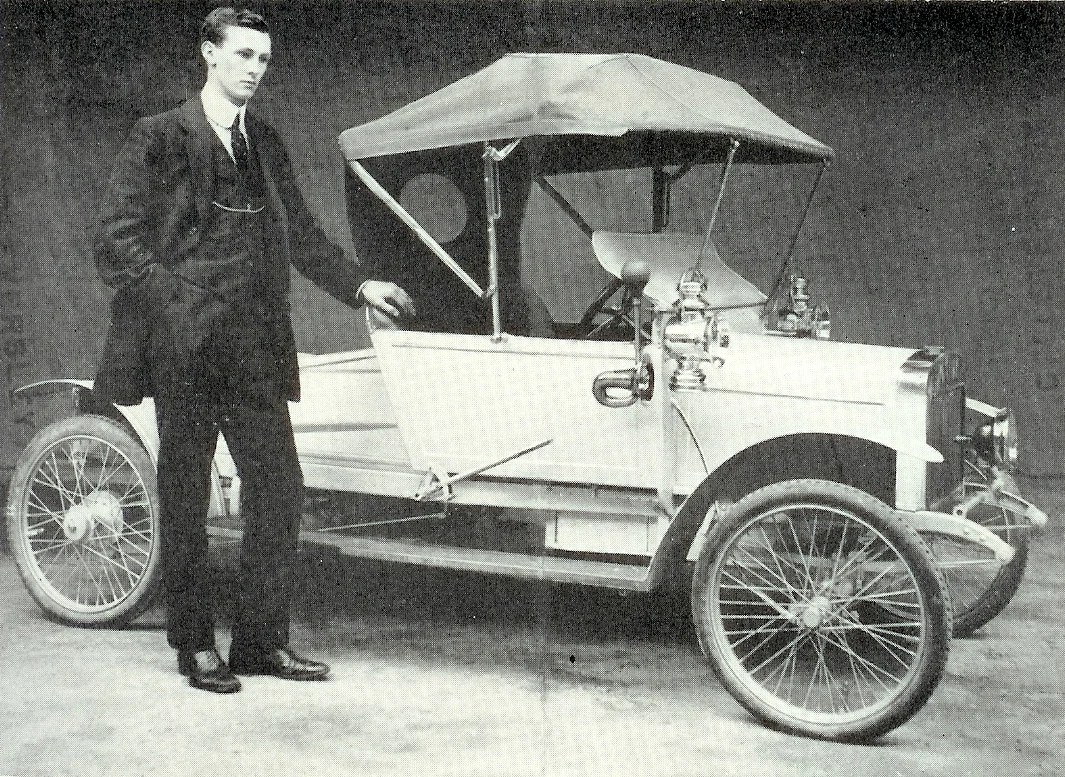
C. M. Keiller with the prototype
Photo A051 · The archive identifies C. M. Keiller beside the original prototype. The small car was the beginning of a much larger ambition.

GWK began with a practical question: could a small car be made easier to drive? Changing gear in an early motor car demanded coordination and confidence. Arthur G. Grice saw another possibility in a variable-speed disc mechanism used on an optical grinder. A friction wheel moving across a rotating disc could change the relationship between engine speed and road speed without the driver having to mesh a new pair of gears.

Grice brought the idea; J. T. Wood and C. M. Keiller helped turn it into a working car. In letters sent to Keith Shaw decades later, Wood remembered a chance lunch and a rough sketch. Keiller recalled that he and Wood were finishing their engineering training at the Great Western Railway works in Swindon when the partnership took shape. These were personal recollections, but they bring the initials on the radiator vividly to life.

Leslie Stead’s history dates the undertaking to 1910 and records an initial contribution of £200 from each partner. Experimental cars were built at Beckenham before production moved to Datchet. The first machines were modest in size and means. Their significance lay in making an unconventional transmission work in a car that people might actually buy.

In a recorded conversation with Keith Shaw in 2004, Wood’s daughter, Mrs Millar, recalled a different route into engineering: her father had first considered a legal career, then went to Swindon, where he met Keiller. She remembered her parents describing the confidence of the years before the war. Her account supplies a family perspective, rather than a contemporary record of the partnership’s finances.

The founders did not remember every detail in the same way. Keiller later put the Type A run at about 25 cars, while Stead gave a substantially higher figure. The evidence supports a small beginning and rapid development more securely than it supports a single exact production total.
Evidence for this chapter: [source][source][source]

1911–1914

A proper little car, with the engine behind you

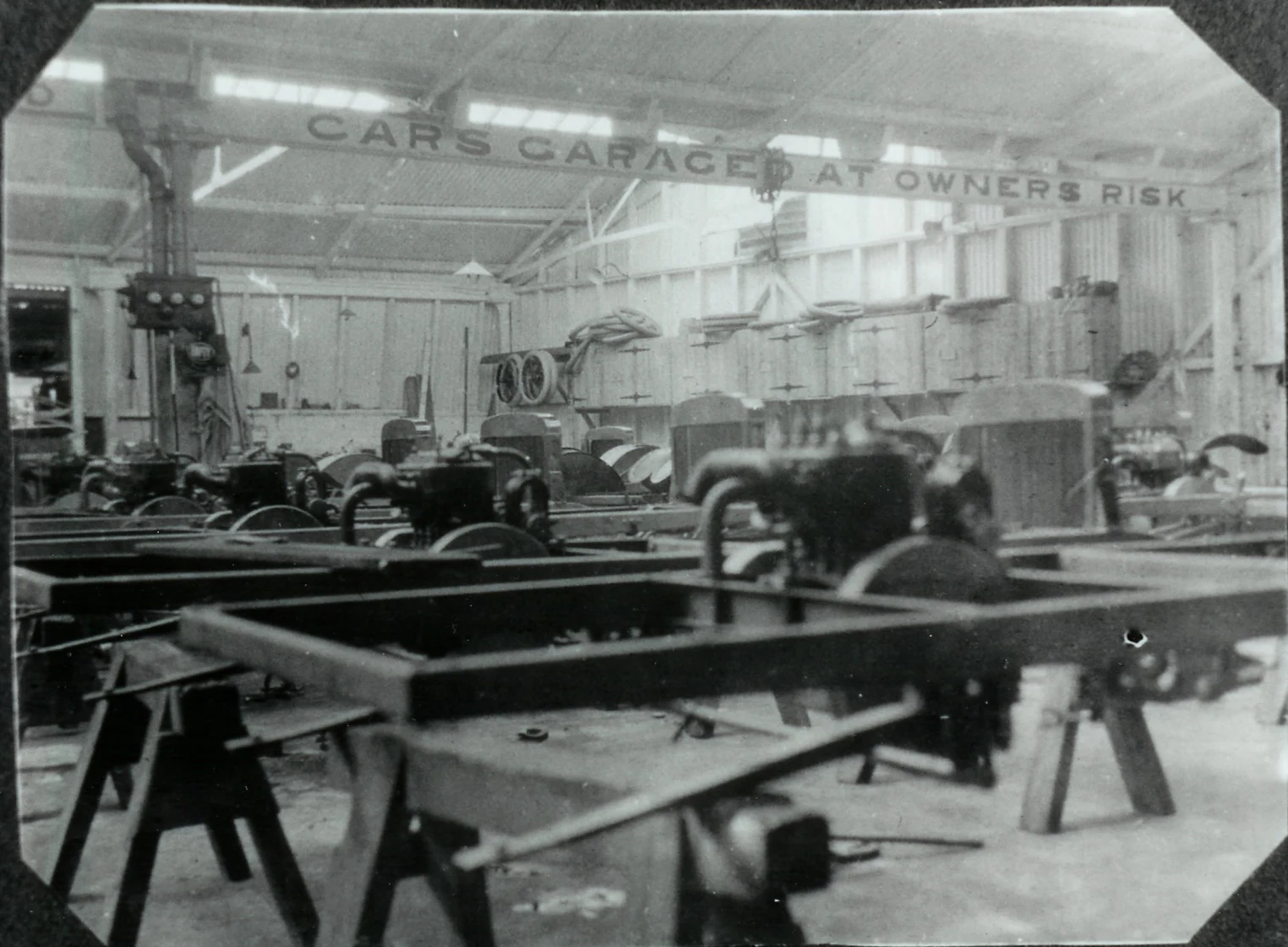
Inside the Home Works: production view
Photo A047 · Cars and chassis inside the Datchet Home Works: the friction-drive idea becomes workshop production.

By November 1911, a GWK advertisement was already giving the Home Works address at Datchet. An early GWK looked reassuringly like a motor car in miniature: radiator, bonnet, running boards and two seats. Its mechanical layout held the surprise. The water-cooled, two-cylinder Coventry-Simplex engine sat transversely behind the occupants. The space under the small front bonnet was not an ordinary engine compartment.

The Type B established the familiar early pattern: a steel channel chassis, rack-and-pinion steering and a rear-mounted power unit driving through the friction mechanism. Access to the machinery was unusually direct once the body hatches were opened. The arrangement suited a compact two-seater, although it limited the room available for additional passengers.

A surviving sales leaflet headed “8 h.p.” offered the irresistible pairing of 45 miles an hour and 45 miles to the gallon. Those were the manufacturer’s sales claims, rather than a guarantee for every road and driver. The same literature specified an 86 mm bore and 92 mm stroke, a twin of roughly 1.07 litres. Its quoted 9.2 rating belonged to the contemporary taxation system; it should not be mistaken for measured engine output.

For a purchaser, the attraction was a combination of manageable size, economical running and freedom from difficult gear changes. Hood, windscreen, lamps and other equipment mattered too: a low chassis price was only part of the cost of a usable touring car. The brochures reveal a firm selling everyday independence as energetically as mechanical novelty.

Evidence for this chapter: [source][source][source][source]

1912–1914

Brooklands put the initials on the map

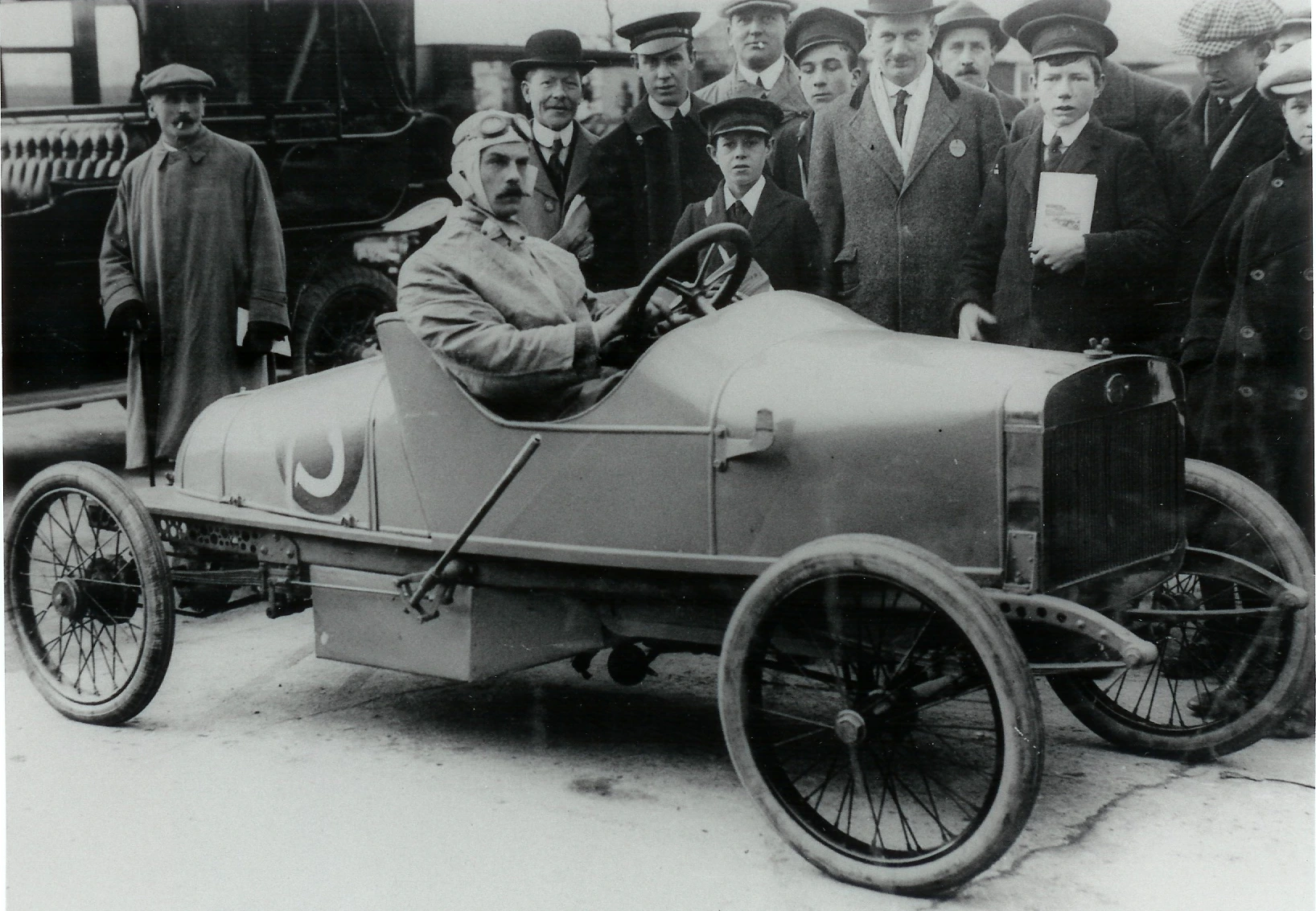
J. T. Wood in a racing GWK
Photo A038 · J. T. Wood in a special-bodied racing GWK, probably at the Brooklands start, circa 1912. The identification, approximate date and location follow the archive label.

A young manufacturer needed more than a clever explanation. It needed its cars to be seen succeeding. GWK entered races, hill-climbs and reliability trials, turning competition results into persuasive advertisements for a small and unfamiliar make.

Brooklands supplied the most dramatic headlines. Wood and Keiller pursued cyclecar records, and the company’s promotional booklet celebrated an hour’s distance of 56 miles and 76 yards in 1912. That achievement belonged to a competition car and a record attempt. It does not establish that a customer’s standard touring GWK would cruise at the same speed.

The same booklet tells a particularly good story about the Albert Brown Trophy race: the GWK finished first, but its classification as a cyclecar prevented it from receiving the trophy. According to the company’s account, a special silver cup was presented instead. GWK made full use of the publicity value of a little car beating expectations.

For Mrs Millar, Brooklands was also a childhood place. In her conversation with Keith Shaw she remembered a later visit, as a small child in the 1920s, crossing the bridge above the track. The smell of hot oil could still bring back the visit.

There were limits to the principle when power rose. Writing much later, Keiller recalled that a highly tuned four-cylinder competition installation could destroy its friction lining during a Brooklands lap. He distinguished this from satisfactory running with the less powerful twins. It is a useful reminder that success in a light car did not automatically solve the demands of every larger, faster application.

Evidence for this chapter: [source][source][source][source]

1912–1913

The Scottish Trials: success over six days

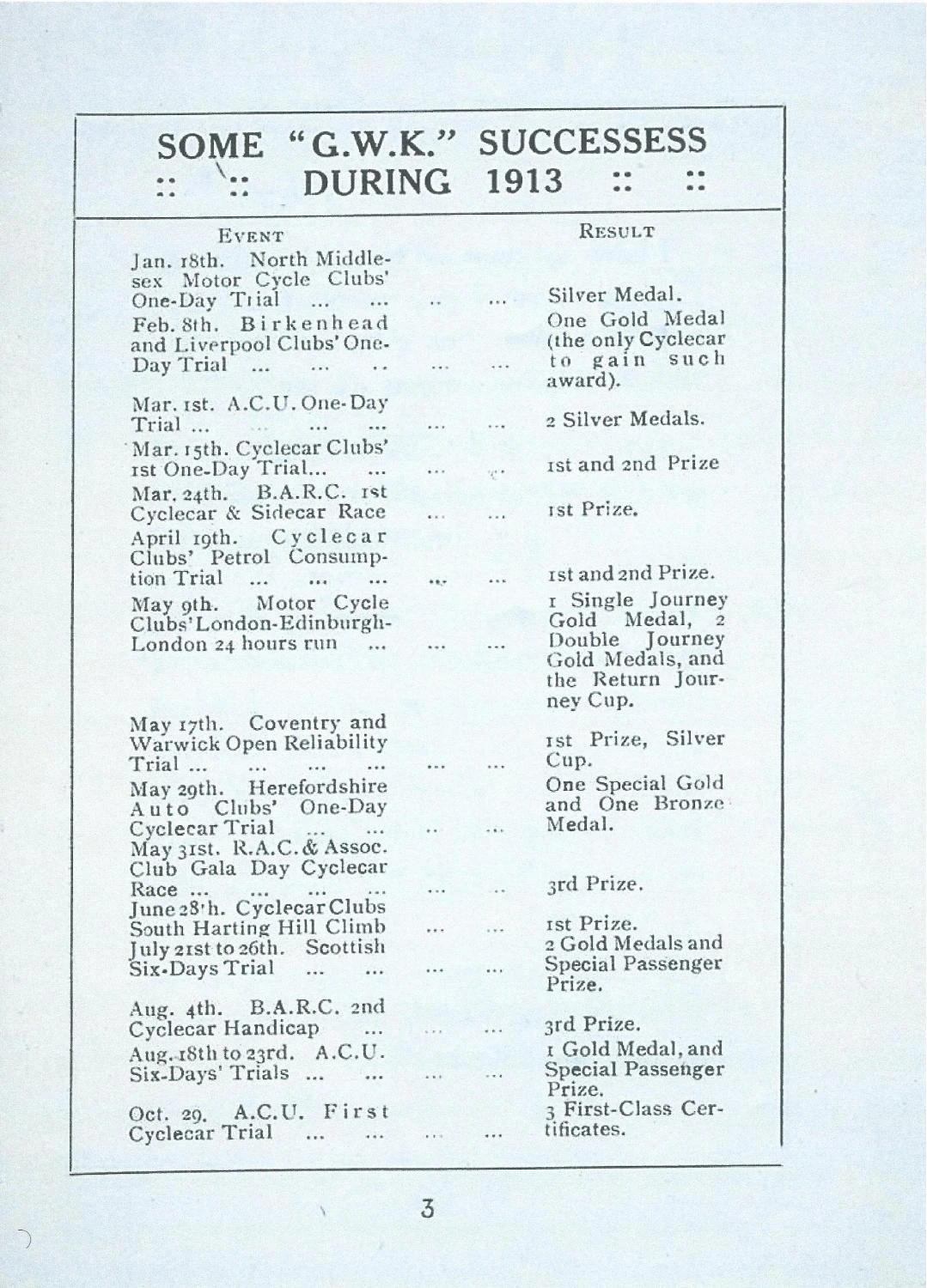
GWK booklet results page listing two gold medals and the special passenger prize at the Scottish Six Days Trial, 21–26 July 1913.
Image H003 · GWK’s own record of its 1913 competition successes. The Scottish Six Days Trial appears near the foot of the page.GWK promotional booklet, catalogued as 1914, p. 3. Click the image to enlarge.

Reliability trials gave GWK a different way to demonstrate its abilities from racing at Brooklands. Sustained running and carrying a passenger offered evidence that mattered to a prospective owner. The Scottish Six Days Trial became part of the small car’s early competition story, and the company made its awards a selling point.

The archive’s promotional booklet, GWK Cyclecars: What They Have Done and What the Public Think, lists a gold medal, a bronze medal and a special passenger prize in the Scottish Six-Days’ Reliability Trial during 1912. These are the results recorded by the manufacturer in its contemporary sales literature.

For the Scottish Six Days Trial held from 21 to 26 July 1913, the same booklet records two gold medals and the special passenger prize. It is a clear record of repeated success, although this results list does not name the individual medal-winning drivers or explain how the passenger prize was judged.

The family archive adds a more personal glimpse. In her recorded conversation with Keith Shaw in 2004, J. T. Wood’s daughter, Mrs Millar, recalled that her mother had accompanied Wood at the Scottish trials in 1913. Alongside the formal results, that memory brings the passenger’s part in these early motoring adventures into view.

GWK also won cups, but the booklet places them at other events. Its 1913 list includes the Return Journey Cup in the Motor Cycle Club’s London–Edinburgh–London run on 9 May, and a first prize and silver cup in the Coventry and Warwick Open Reliability Trial on 17 May. Those successes belong alongside the Scottish medals in GWK’s wider competition record; they are separate events.

Evidence for this chapter: [source][source]

1913–1917

The road test that lasted 20,000 miles

The most convincing picture of early GWK motoring comes from an owner who had lived with the cars. In April 1917, The Light Car & Cyclecar published an account of more than 20,000 miles with two 1913 GWKs. The journeys took in Scotland, Wales, the Yorkshire Dales and the Peak District, with a wife and luggage aboard.

The writer reported an overall average of about 46 miles to the gallon and treated roughly 30 mph as a comfortable travelling speed. This was a world of long days on varied roads, with gradients, weather, tyres and repairs shaping the journey. The appeal of the GWK was the ability to choose a suitable ratio quickly and keep going.

Ownership required involvement. The article discussed lubrication, adjustments, rattles and improvements to luggage space. One striking passage described the owner and his wife using pulleys to lift the body, attend to the engine and refit everything within a few hours. The GWK was transport, but it was also a machine its owners expected to understand.

The account was not uncritical. It included a frightening episode in which an adjustment interfered with the linked foot brake. Decades later, another owner recalled leisurely tours at about 25 mph and the excitement of touching 40 downhill. Such accounts give the history texture: affection for the car coexisted with noise, maintenance and very different expectations of braking and speed.

GWK’s own booklet collected glowing customer letters from Britain and overseas. These show how the cars travelled and how owners described them, but they were selected for publication by the manufacturer. Their enthusiasm belongs alongside the independent road accounts, rather than standing in for them.

Evidence for this chapter: [source][source][source]

1914–1918

War interrupted the small-car success

The First World War disrupted the business, its workforce and its supply of engines. The works moved from Datchet to Maidenhead during this period; an August 1915 advertisement already gives the Cordwalles Works address. The archive traces continued development of the twin-cylinder car, including the Dorman-engined Type E, while government work increasingly took priority. In a 1917 advertisement, GWK told would-be customers that serving the government meant it could not yet serve them.

The advertising also found a wartime application for easy control. In January 1916, GWK promoted the car to officers who had lost a leg, presenting its driving arrangements as a route back to independent motoring. That was the manufacturer’s claim, but it shows how directly the company connected its engineering to the lives of prospective owners.

Mrs Millar remembered that Wood’s knowledge of cars and machinery had been useful during his military service. In her account, he was employed in France looking after tractors that hauled guns. She also recalled his sadness that the promising business he had left before the war had changed so much by his return.

Behind that message, a much more ambitious post-war car was taking shape. Moving a four-cylinder engine to the front made room for more conventional passenger accommodation. The friction transmission remained central to the design, but the architecture around it changed substantially.

The Motor described a new experimental GWK in November 1917. Reports and a factory visit published in January 1919 showed the design continuing to evolve. Features included a long drive shaft to the rear mechanism and a mechanical starter that could be operated from the driving seat. These reports describe development cars; their details should not all be treated as the specification of every later production model.

Evidence for this chapter: [source][source][source][source][source][source]

1919–1921

A bigger car and a much bigger undertaking

Model F tourer
Photo A045 · An archive photograph identified as a Type F tourer. The front-engined four-cylinder car changed the scale of GWK’s ambitions.

The Type F carried the post-war promise into production. Its four-cylinder engine was installed under the bonnet, with power taken rearwards to the friction drive. The arrangement of the rear axle, differential, shafts and geared wheel hubs was considerably more elaborate than the compact early twin’s layout.

The November 1920 catalogue described the familiar 66 by 100 mm four-cylinder engine, approximately 1,368 cc, and a 10.8 Treasury rating. It offered the comfort and presentation buyers expected of a more substantial car while continuing to make easy control a central selling point. Customer testimonials praised hill-climbing and the speed with which beginners learned to handle the transmission.

A later Motor Sport interview with factory tester W. A. Wheeler adds the workshop view. Before bodywork was fitted, chassis went out on rough-road tests with little more than two metal bucket seats: no windscreen or mudguards to shelter the testers. His surviving test records repeatedly drew attention to noise from the rear-wheel reduction gears. Development involved many small, practical corrections.

Wheeler’s evidence also complicates the familiar engine specification. The factory used Perkins engines of the same nominal capacity when sufficient Coventry-Simplex units were unavailable. A surviving car’s engine, its catalogue description and the specification usually quoted for its model therefore need to be checked together.

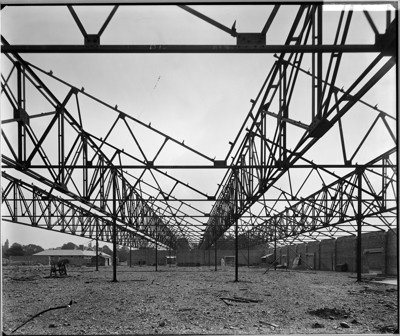
Expansion at Maidenhead was intended to support this future. A dated photograph in Historic England’s collection records an assembly shop under construction at the Cordwallis Works in September 1920. It fixes the physical growth of the factory within the same period in which the company’s finances were coming under severe strain.

Steel columns and roof trusses of GWK’s assembly shop during construction at Cordwallis Works, Maidenhead, September 1920.
Image H004 · Building the assembly shop at Cordwallis Works, Maidenhead, September 1920. The steel frame shows the scale of GWK’s factory expansion.Adolphe Augustus Boucher, Bedford Lemere & Co. · Historic England Archive, BL25066/002. View the archive record.

The founders’ later letters reveal disagreements about the direction of the business. Grice left in 1920, and Wood and Keiller looked back critically on the accumulation of changes to the post-war car. Their testimony is valuable precisely because it is personal. It records disappointed engineers as well as technical judgments, and is best read beside the contemporary company papers.

Evidence for this chapter: [source][source][source][source][source]

1913–1920

Selling freedom, with Miss GWK in the driving seat

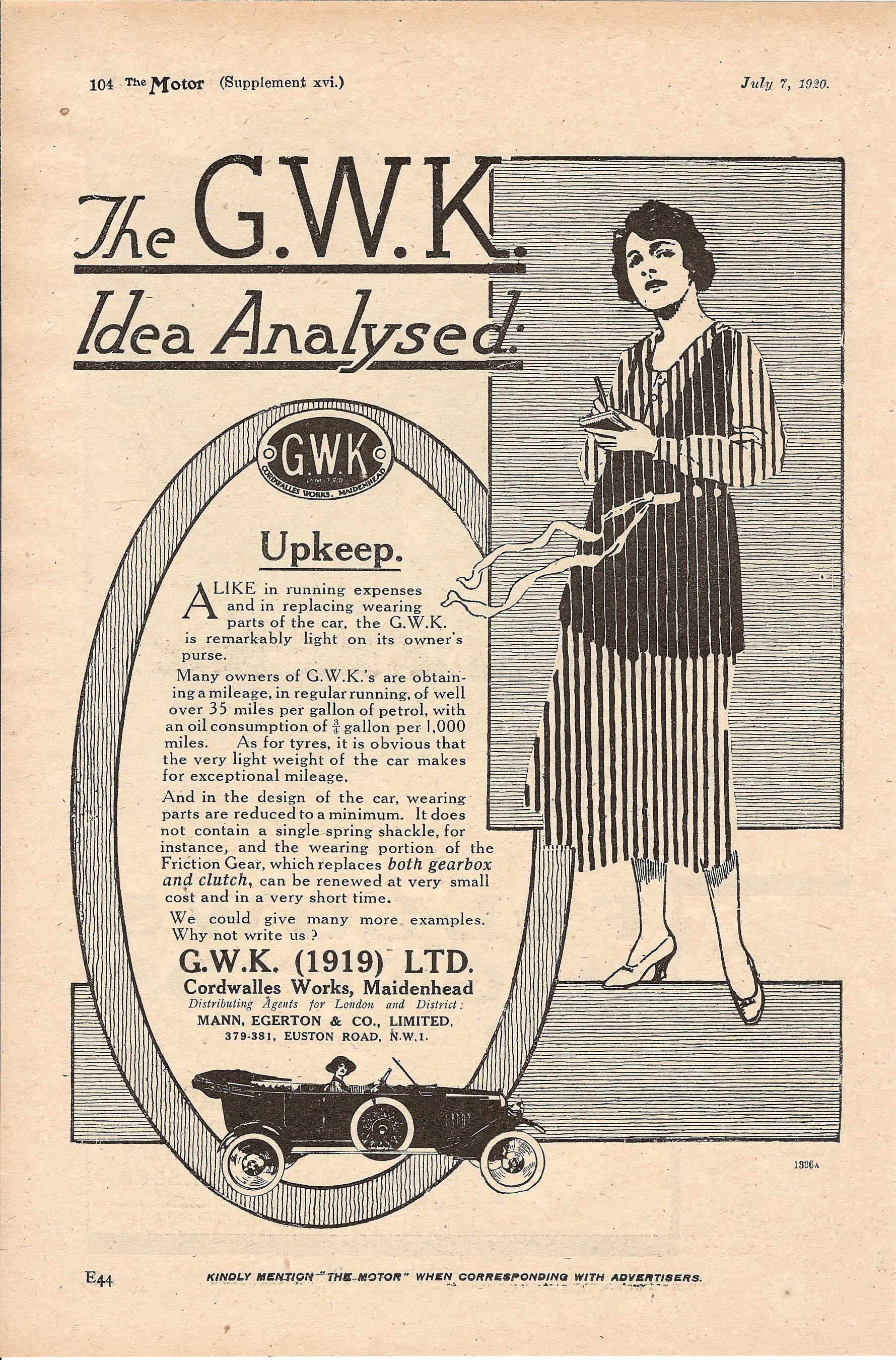
Miss GWK in an advertisement headed The G.W.K. Idea Analysed: Upkeep, promoting low running and maintenance costs.
Image H001 · Miss GWK promotes economical motoring in The Motor, 7 July 1920, p. 104. The running-cost and maintenance claims form part of the company’s advertising.Click the image to enlarge.

GWK sold an experience as well as a mechanism. The promise was independence: a car an owner could handle without a chauffeur or a mechanic’s training. Competition results provided credibility, customer letters offered reassurance and a distinctive advertising voice made a small manufacturer hard to overlook.

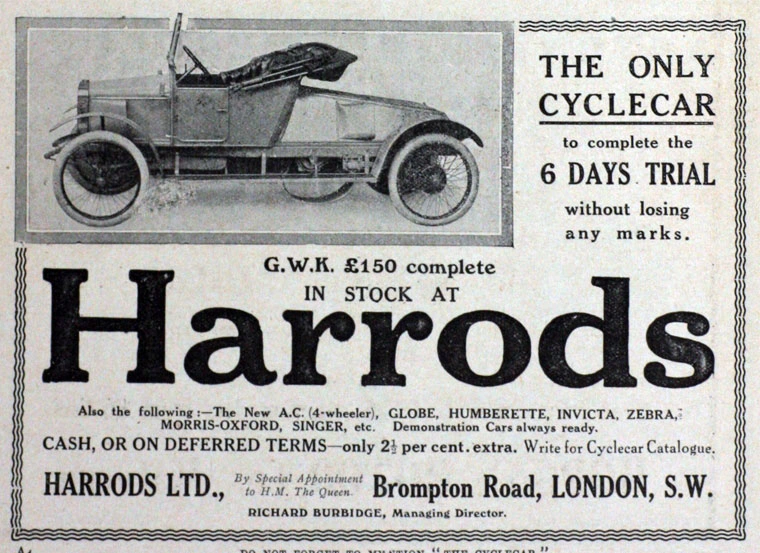
The sales channels could be surprisingly grand. In March 1913, Harrods advertised a complete GWK at £150 alongside other cyclecars, offering cash purchase or deferred terms. A little car from Datchet had found a place in one of London’s best-known department stores.

Harrods advertisement offering a GWK for £150 complete, with cash or deferred payment terms and a claim about its Six Days Trial performance.
Image H002 · A GWK for £150 complete, in stock at Harrods. This advertisement combines a claim about the Six Days Trial with the appeal of a famous retailer and deferred payment terms.Archive label: The Cyclecar, 3 September 1913. Scan credited in the filename to Grace’s Guide. Click the image to enlarge.

Women drivers were explicitly part of the appeal. The recurring Miss GWK character gave the advertisements a lively female voice and a motoring identity. An Autocar advertisement of 7 February 1920 addressed women directly, using the leap-year custom of women proposing marriage as a playful opening. It then turned to the car’s simple controls, running costs and hill-climbing ability. These were invitations to take part in motoring, expressed through the conventions and humour of their period.

Not every advertisement featuring Miss GWK was aimed only at women. On 17 January 1920, she was presented as the persuasive advocate for a car suitable for a man of limited means who wanted to drive himself. The campaign used a recognisable personality to challenge the buyer’s habits, rather than relying entirely on diagrams and specifications.

The November 1920 brochure made the ease-of-driving argument more personal. One selected customer letter said that the writer’s wife, who had never driven before, learned in two half-hour lessons. This is a manufacturer-selected testimonial, not a measured learning standard, but it shows exactly what GWK wanted prospective drivers to imagine: confidence behind the wheel without a long apprenticeship.

The advertisements also reveal the scale of the gamble. In February 1920, Miss GWK looked forward to roads full of cars while the copy acknowledged delivery delays and promised new workshops. A June advertisement argued that simpler machinery would support large-scale production and lower costs. Those promises make the following year’s financial papers especially poignant: the company was promoting the very expansion that would leave it so exposed.

Evidence for this chapter: [source][source][source][source][source]

1921–1922

Parts for thousands of cars. Too few complete cars.

The 1921 directors’ report explains the financial crisis with unusual clarity. The company had committed itself to expansion and component orders during the post-war boom. Factory building ran late; industrial disruption and shortages prevented essential parts arriving together. By the time cars could be completed, the market had turned and orders were being cancelled.

For the sixteen-month accounting period ending on 31 December 1920, the report recorded a loss of almost £197,500. An accompanying expert report described an extraordinary imbalance: stocks of some components were sufficient for 5,000 cars, while other necessary components were missing.

The papers describe falling stock values, the cost of unfinished expansion and proposals to reorganise production, purchasing and sales. They make the collapse more understandable than a simple verdict that friction drive did not work. A small specialist manufacturer had become exposed to a sharp change in trading conditions, with money tied up in the wrong places.

Technical difficulties still mattered. Later accounts discuss vibration, friction-lining behaviour and the challenges of the heavier car. Wood and Keiller also recalled the burden of commercial-vehicle guarantees. The firm entered receivership in 1922, but this was not the end of the cars or the final disappearance of the name.

Evidence for this chapter: [source][source][source]

August 1922

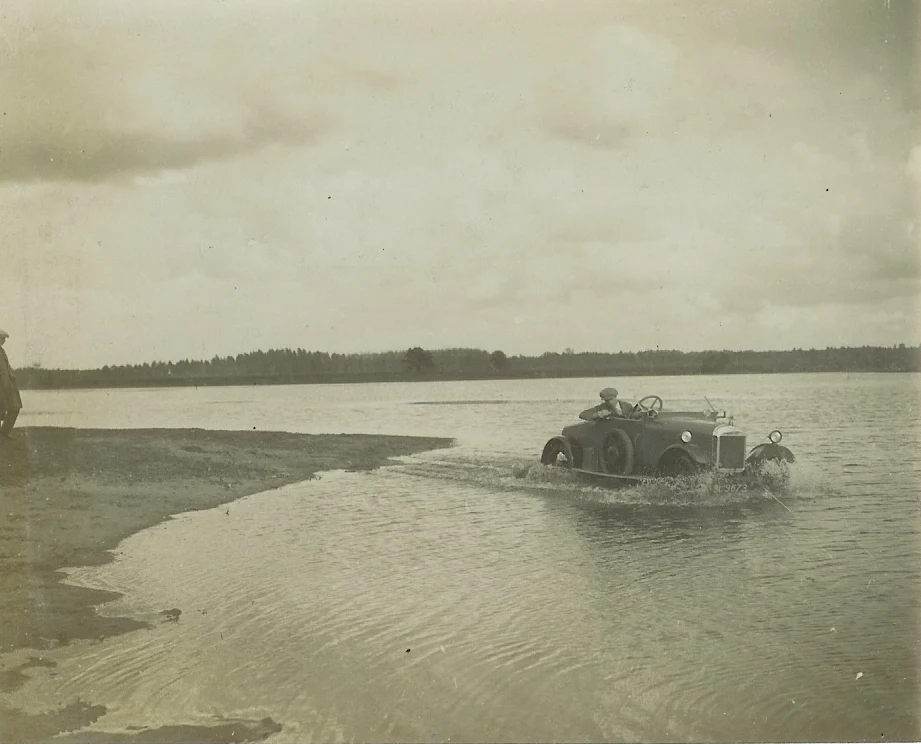
Into the sand, through the gorse and into the pond

Frensham Common trials: view 1
Photo A043 · The archive dates this water-crossing photograph to August 1922. The Frensham report describes a car repeatedly driven through the pond as part of the demonstration.

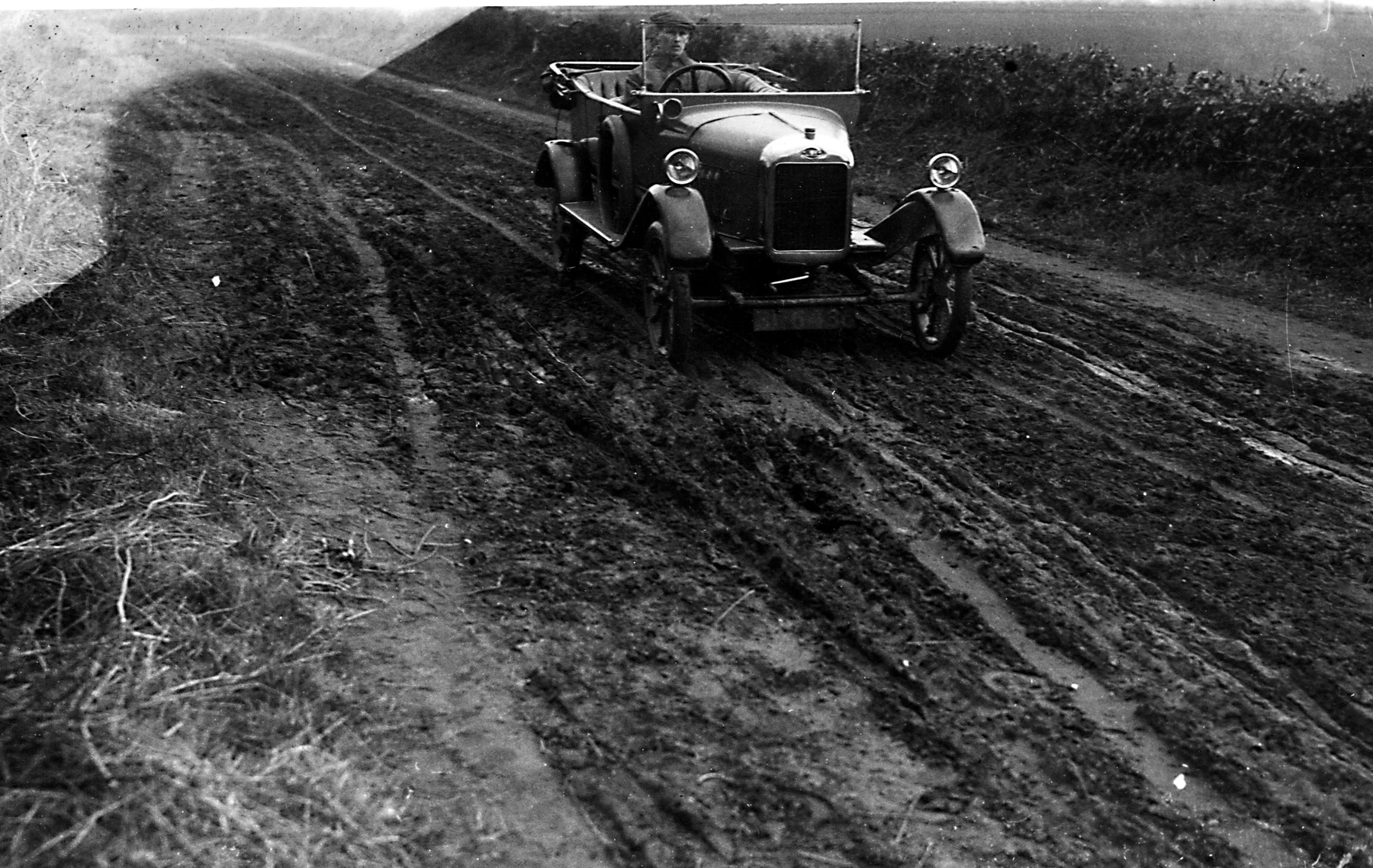
On 31 August 1922, a GWK was put through a demonstration near Frensham that reads more like an ordeal than a road test. H. G. Pope drove over deep sand, steep banks and rough heath, with passengers adding to the load. Chains on the rear tyres helped it find purchase.

The Light Car & Cyclecar reported repeated crossings of the pond and water rising around the running boards. On land, the car tackled gorse and uneven ground. The performance offered a memorable answer to anyone who doubted that friction transmission could do useful work under difficult conditions.

The report also recorded the qualifications. In deep sand the wheels could dig in, and water trapped around the transmission temporarily prevented the discs from driving. Once drained and dried, the mechanism worked again. The story is stronger with those details intact: an impressive demonstration of recovery and endurance, rather than a claim that nothing ever went wrong.

Evidence for this chapter: [source]

1922–1926

Refinement, new bodies and a second chance

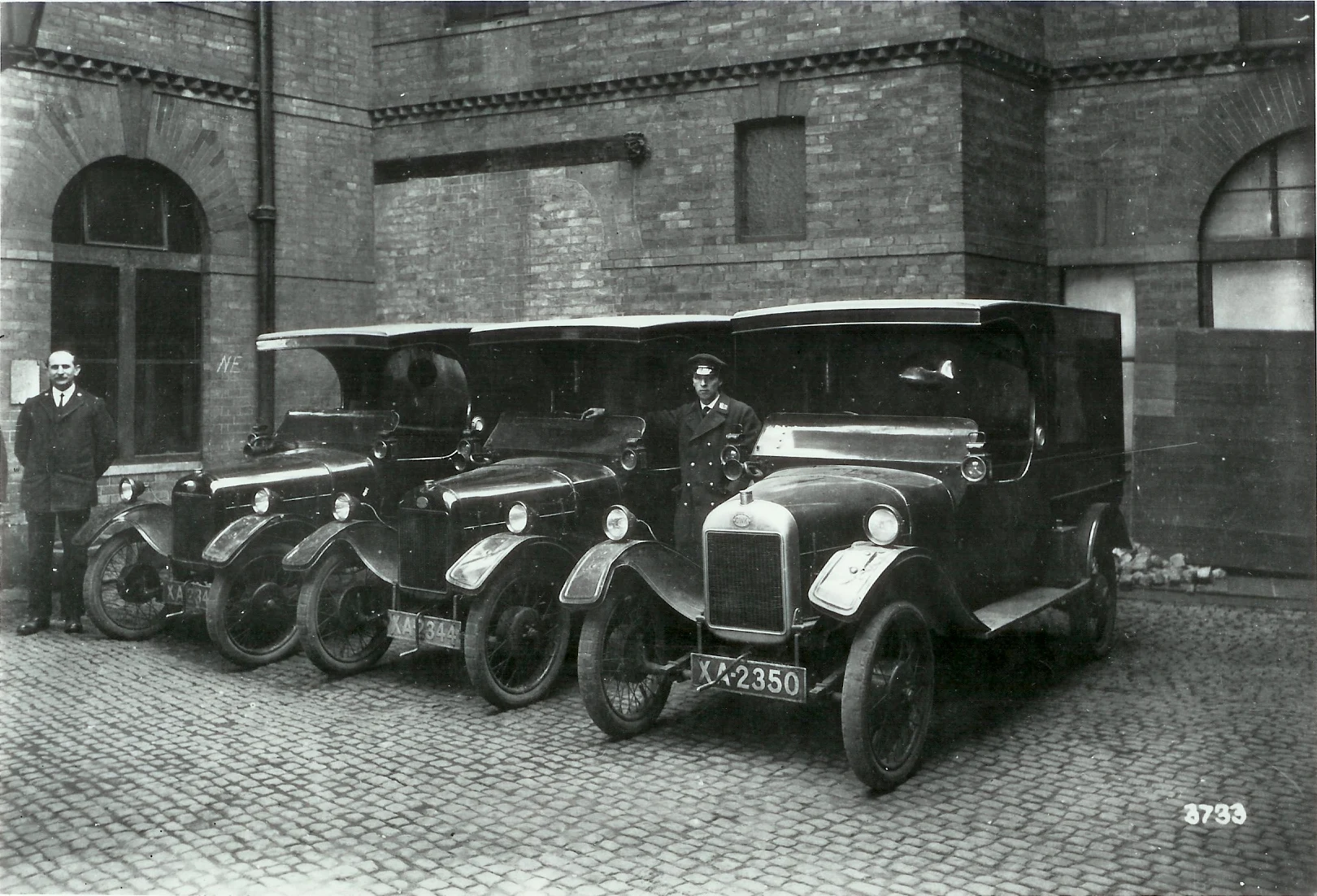
GWK postal vans at Leicester
Photo A014 · GWK postal vans in the archive. The founders’ letters identify the Post Office vehicles as four-cylinder cars; the exact date and individual vehicles need further documentation.

The Type H brought further work on the chassis and transmission installation. Contemporary publicity continued to stress an easily chosen ratio for every gradient, while mechanical refinements aimed to reduce noise and improve everyday use. Later helical final-drive gearing should not be mistaken for the abandonment of friction transmission.

By the 1923 motor-show season, the advertised range offered an appealing variety of bodies. A 10.8 h.p. two-seater was listed at 200 guineas, with four-seater and de luxe versions above it. A 12 h.p. coupé and a semi-sports model broadened the offer. The larger four-cylinder option used a 69 mm bore and 100 mm stroke, giving approximately 1,496 cc.

These were attempts to keep a distinctive car attractive in an increasingly competitive market. Brisby’s later history singles out the Austin Seven and Morris Cowley as rivals that made life harder for small manufacturers. Price, weather protection, equipment and reliability all mattered to buyers. GWK needed more than a clever transmission: it had to offer a complete car at a price the business could sustain.

Grice’s related Unit venture belongs in this period, but Unit was a separate marque. Michael Worthington-Williams’s later research traces the relationship between the businesses and the 1923 purchase of GWK parts, tools and unfinished cars by Grice and Van Roggen. The overlapping people and machinery can easily confuse the story if every Grice design is simply called a GWK.

The cheaper HK and later proposals show continued efforts to find a viable offering. Regular GWK production is generally placed as ending in 1926. Small runs, remaining components and experiments make a single last-car date harder to establish than that broad statement suggests.

Evidence for this chapter: [source][source][source][source][source]

1926–1931

The last car was another fresh idea

Leslie Stead’s recollection of working at the factory in 1926 preserves a vivid final glimpse of the business: messages carried through the shops, fascinating machines that distracted an office boy from his duties, and GWK sharing exhibition space with Imperia. The works continued to have a motoring life beyond the main GWK production years.

In his fuller 1982 account, Stead described T. H. Painter gathering the remaining parts, drawings and equipment into a smaller concern after the Imperia reorganisation. Repairs and spares kept existing GWKs on the road, and new cars could still be offered to special order. This was a much reduced operation, quite different from the grand expansion planned in 1919.

Then, in June 1930, The Autocar announced that GWK had been reintroduced. The subject was an experimental rear-engined four-cylinder car with a low, punt-like structure and room for four. Its body used a permanent canopy frame with a roof that could be rolled back. The front radiator remained, while the engine sat behind the rear passengers.

The report mentioned a proposed price of about £160 and described further ambitions for a cheaper car. These were proposals, not proof of a successful production revival. Later histories place the final closure in 1931.

GWK ultimately failed as a motor business. The evidence points to several pressures acting together: disagreements over direction and a demanding programme of design changes within the company; war, supply disruption and the post-war slump outside it; expansion costs, stranded component stocks and mounting competition at the point where engineering met the balance sheet. No single mechanical flaw explains the whole collapse.

That failure should not obscure what GWK achieved. It put a manually controlled, continuously variable transmission into customers’ hands, developed unusual chassis and control arrangements, and sold the promise through competition, demonstrations and imaginative advertising. Regular manufacture ended in 1926, the experimental car appeared in 1930 and final closure followed in 1931. The business ran out of road while the ideas kept coming.

Evidence for this chapter: [source][source][source][source][source][source][source][source]

Memories of 1926 · recorded in 1958 and 1982

Remembering GWK: Leslie Stead’s recollections

Leslie Stead helped preserve the story of GWK by writing down his memories of the company and its people. A former employee, he brought a personal perspective to the history: the experience of being at the works, alongside the story of the cars themselves. His writings remain a valuable part of the archive assembled for this project.

In a letter published in Motor Sport in September 1958, Stead looked back on working at GWK in 1926. He recalled carrying messages through the workshops as an office boy and being distracted by the machinery that fascinated him. These small details give us a glimpse of the factory as a workplace, seen through the eyes of a young employee.

He also remembered GWK sharing exhibition space with Imperia. His recollections capture a period of change, when the works and the people associated with it were adapting as regular GWK manufacture drew to a close.

Stead returned to the wider story in Days of Friction, published in Classic and Sportscar in June 1982. He described T. H. Painter gathering the remaining parts, drawings and equipment into a smaller concern after the Imperia reorganisation. Repairs and spares helped keep existing cars running, while new cars could still be offered to special order.

His contribution extended beyond those personal memories. His history of GWK helped preserve accounts of the early undertaking and the development of its cars. The distinction matters: his memories of the 1926 workplace are first-hand recollections, while his account of the earlier years is a retrospective history.

By taking the time to record what he remembered and what he had learned, Leslie Stead left later enthusiasts and the founders’ families a richer picture of GWK. His recollections add the human detail that photographs, specifications and company papers alone cannot provide.

Evidence for this chapter: [source][source][source]

1950s onwards

The people who kept the story moving

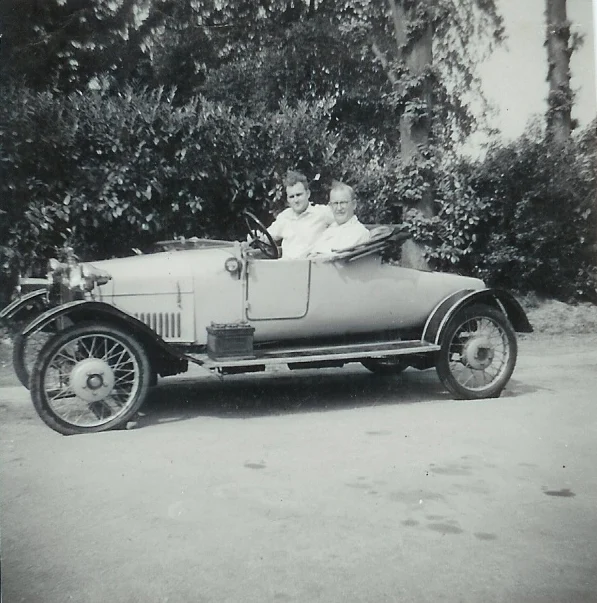
Keith after collecting the car
Photo A026 · Keith Shaw with the family GWK in an archive photograph dated 1959. His research and correspondence helped preserve the founders’ accounts.

The GWK story survived through owners who kept cars, parts, photographs and memories when the factory could no longer speak for itself. Keith Shaw, Arthur G. Grice’s grandson, helped preserve that family connection. His correspondence with Wood and Keiller in the late 1950s recovered accounts that would otherwise have been lost. Their letters discuss origins, models and engineering problems, but also convey the pleasure of hearing that somebody still cared about the cars.

The documents themselves had adventures. In the 2004 interview with Mrs Millar, Keith described how a metal box discovered in the roof of Grice’s former home had yielded apprenticeship and voyage records. A visit to the motoring archive, newly found photographs and an early sales leaflet then opened further paths into the story. Research depended on families recognising the value of what had survived.

Restoration could be an exercise in detection. The Automobile’s 1984 account of Chris Jaques’s cars described a search for a suitable engine that led to a GWK chassis being used with a sawbench. Tracing an earlier owner’s family then helped explain an apparently incorrect overhead-valve engine: it was a period modification, part of that particular car’s life.

A gathering at the old Maidenhead works in 1984 brought together five GWKs, owners and former employees. Keith Shaw attended with his Type F; Hilda Kitson’s much-used twin-cylinder car demonstrated that preservation could mean regular outings. Even then, the best friction material remained a lively subject of discussion.

Keith Shaw owned two GWK cars and bequeathed one of them, his 1921 four-cylinder car HO 7192, to Maidenhead Heritage Centre. His contribution was both historical and practical: he preserved the founders’ voices and helped give one of their cars a lasting home in the town where it was made. The centre’s 2022–23 report records the car’s arrival in April 2022, its return to drivable condition and appearances at local events that summer. The surviving cars make the history tangible: a lever moves, the ratio changes, and an idea first explored before the First World War can still be experienced.

A continuing family interest

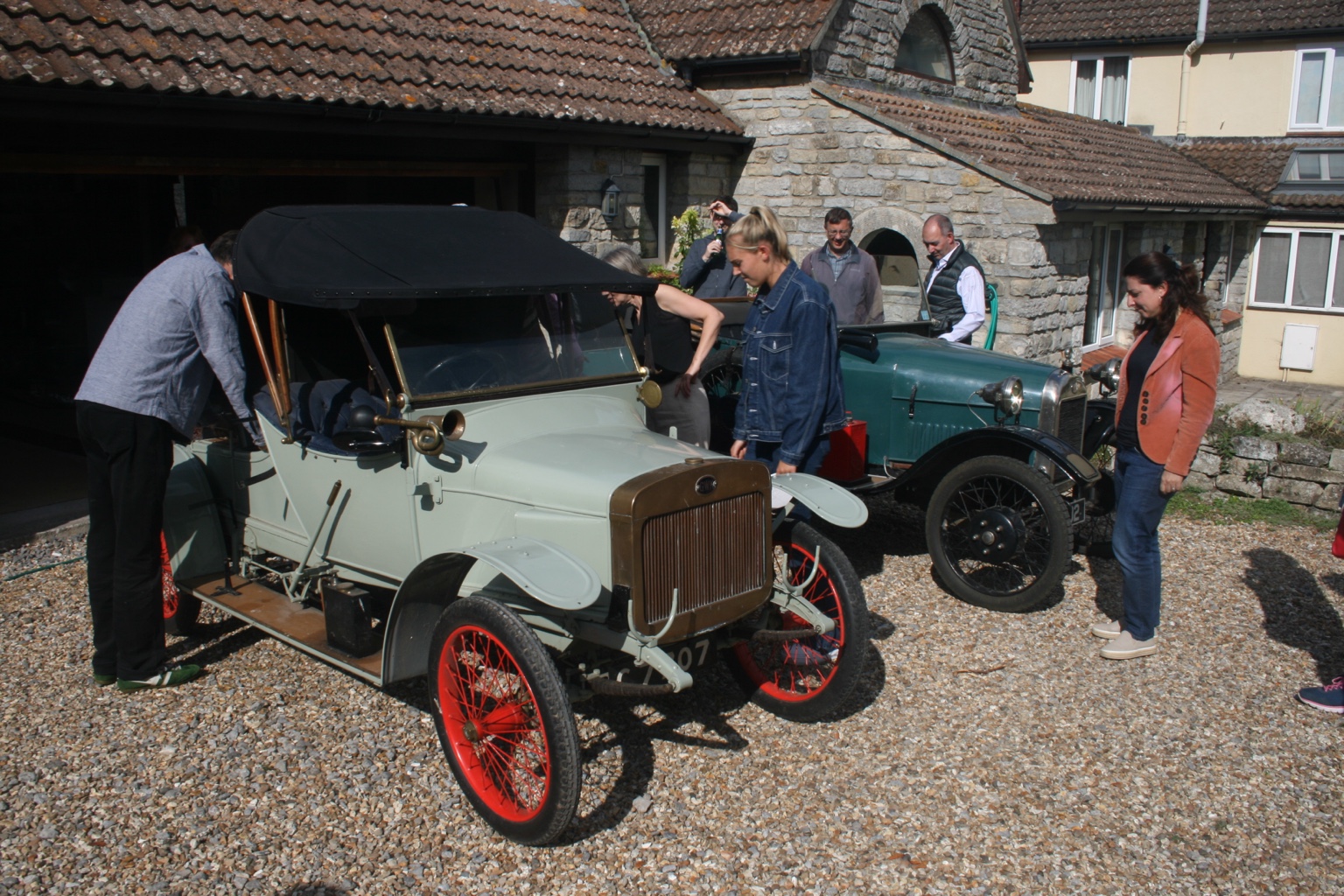
Members of Arthur G. Grice’s family gathered around two GWK cars, a pale car with red wheels in front and a green car behind.
Photo H005 · Members of Arthur G. Grice’s family with two GWK cars, reflecting the family’s continuing interest in the cars and their history.Arthur G. Grice family collection. Click the image to enlarge.
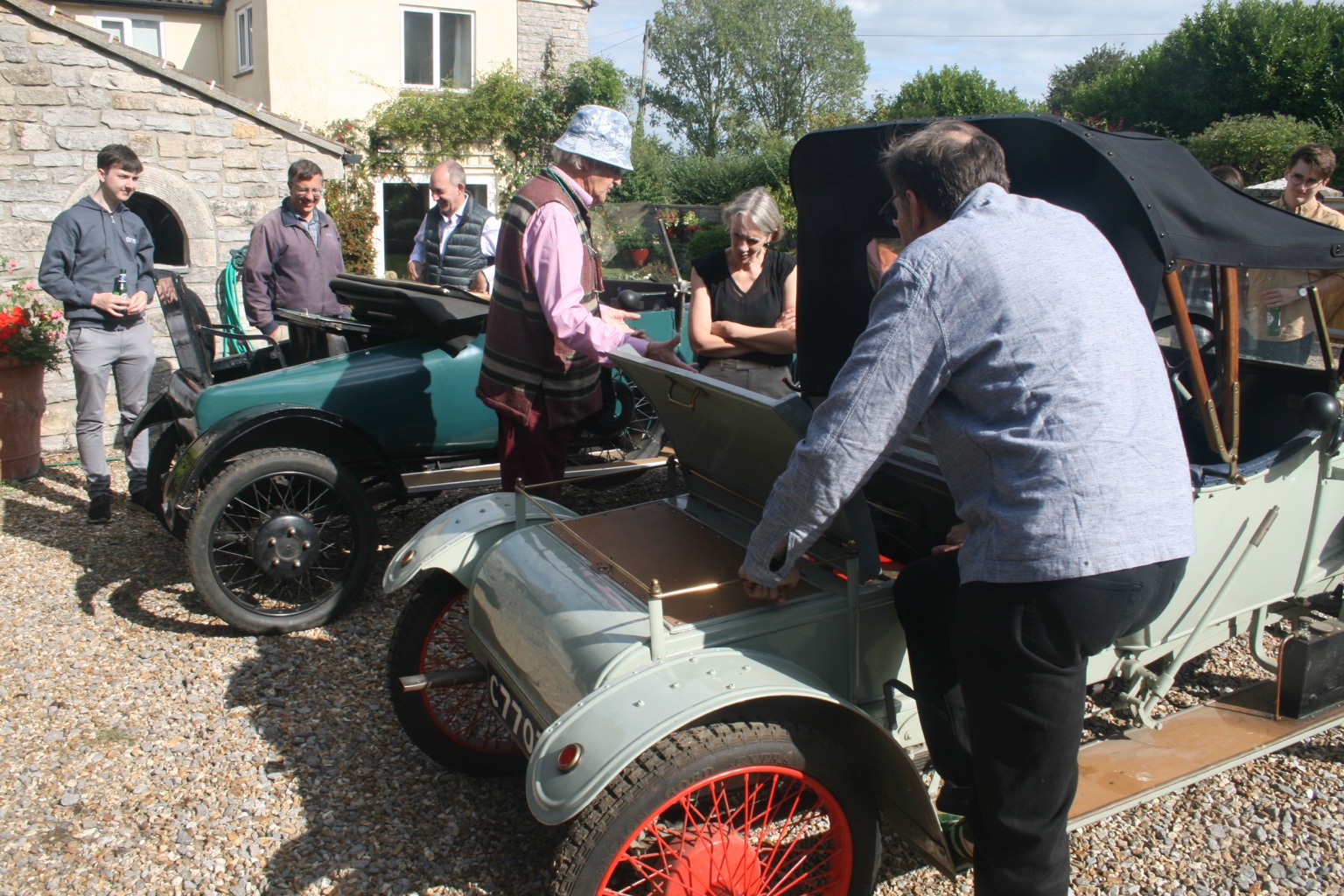
Members of Arthur G. Grice’s family examining a pale GWK with red wheels, with a green GWK behind.
Photo H006 · A closer look at the GWK cars during a family gathering.Arthur G. Grice family collection. Click the image to enlarge.

This archive brings the engineering and the people together. Period advertisements show what GWK promised; tests and manuals reveal what it asked of the driver; company papers explain the risks of manufacture; owners and families carry the story beyond the factory gates.

Evidence for this chapter: [source][source][source][source][source]

1911–1931 · Sales and production

About 2,000 cars. An estimate, not a ledger.

How many GWKs found buyers? The surviving histories suggest a small but substantial business, although they do not establish an audited lifetime sales total. In The Automobile in August 1984, Michael Brisby reported Leslie Stead’s estimate of 2,000 to 2,400 GWKs produced. “About 2,000” is therefore a reasonable shorthand for the scale of manufacture, with the range and its source kept in view. [source]

Stead’s own 1982 account provides useful sales milestones: 52 cars sold by the end of 1911, and about 900 Type F cars sold across 1920 and 1921. He also put 1921 production at about 438. These are retrospective figures, and the last figure overlaps the two-year period; they must not be added together to create a new grand total. [source]

Published histories do not agree on all the totals. This account uses the identifiable Stead estimate while keeping production distinct from completed sales. Nor should the 1921 report’s stock of some components for 5,000 cars be mistaken for 5,000 finished vehicles. The gap between the factory’s ambition and the cars it could complete is central to the story. [source]

Inside the idea

A ratio for the road ahead.

Friction drive on display
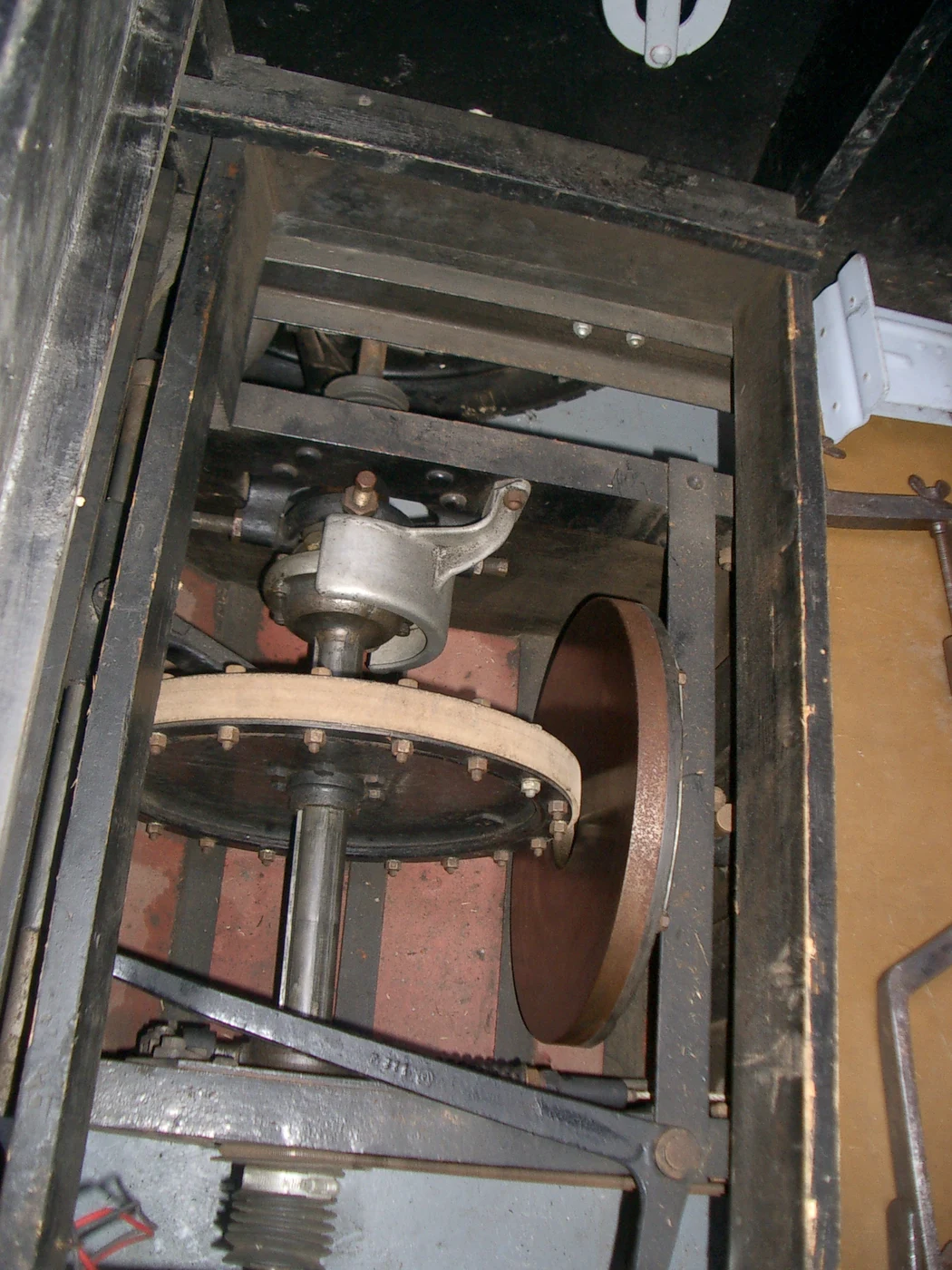
Photo A049 · A view of a surviving GWK’s transmission, photographed at Bentley in 2004. The friction mechanism is the heart of the design; its surrounding layout changed between models.

Imagine the edge of one wheel resting against the face of a rotating disc at right angles. Friction turns the wheel. Move its contact point nearer the disc’s outer edge and it turns faster; move it towards the centre and it turns more slowly. Moving to the opposite side reverses its direction. A central recess provides neutral.

The driver used a pedal to separate the surfaces before moving the change-speed lever. There were familiar notched positions, but the post-war GWK instruction book explicitly allowed intermediate ratios within the forward driving range. The mechanism was continuously variable within its operating limits, although the driver selected the ratio by hand.

In the early twin, the engine’s flywheel supplied the driving face and the drive ran back towards the axle. In the front-engined four-cylinder car, a shaft carried engine power to a separate steel disc at the rear; the driven wheel was carried on a transverse splined shaft. A differential and reduction gears in the rear hubs completed the drive to the wheels.

The manufacturer’s manual explains why driving technique mattered. Gradual slipping could rub a flat into the friction lining. It also warns against leaving the stationary car with the discs pressed together in a driving position. The larger car’s extra-pressure pedal let the driver increase contact pressure when conditions demanded it.

The idea even reached the Meccano workbench. In July 1926, Meccano Magazine published a working model demonstrating variable speed and reverse, alongside a GWK chassis diagram. Young builders could investigate the same principle that drivers were using on the road. [source]

Cork and fibre linings appear in the literature, and later owners continued to debate the best material. The manual’s lubrication charts, adjustment diagrams and fault-finding pages show how much care went into making a simple driving experience possible. These are historical descriptions; the appropriate workshop instructions depend on the individual car.

Technical evidence: [source] [source] [source]

The cars at a glance

One principle. Several very different cars.

Dates below indicate documented introductions or broad periods, rather than precise chassis cut-offs. Engine capacities are rounded. Period “h.p.” labels often describe taxation ratings rather than measured power.

ModelPeriodLayout / engineWhat distinguishes it
A1911–1912Early twin-cylinder carThe first small production series. Accounts disagree over the number built and details of the earliest chassis.
BFrom 1912Coventry-Simplex twin, about 1.07 litresThe best-known early two-seater: transverse engine behind the seats, steel chassis and friction drive.
EFrom 1916Dorman twin, about 1.10 litresA wartime development of the early layout. Later accounts differ over the extent and timing of post-war twin-cylinder assembly.
FFrom 1919Front-mounted four, about 1.37 litresA larger post-war car, with a long shaft to the rear friction mechanism and geared rear hubs.
HAdvertised in 1921; developed through the 1920sFour-cylinder, usually 1.37 litresRevised chassis and transmission installation. The later range included a 1.50-litre option and several body styles.
JDescribed October 1921 for 1922Rear-engined four-cylinder projectAn experimental return to a rear engine. Its production status and the application of model letters remain uncertain.
HK1925 show periodEconomy development of the HA cheaper offering recorded by Stead, as the business sought a place in a competitive small-car market.
1930 revivalReported June 1930Experimental rear-engined fourA low four-seater with a canopy roof. Contemporary reporting describes a proposed car, not an established production series.

Model evidence: [source] [source] [source] [source] [source] [source]

1903–1937 · Beyond the motor car

Arthur G. Grice’s restless inventive mind.

GWK was one expression of a much wider imagination. Arthur G. Grice’s patent papers range from heavy machinery to everyday objects, with a recurring interest in movement, control, wear and repair. The family archive lets us follow the ideas in his own specifications.

His automotive work went well beyond the original transmission layout. Papers cover flexible shafts and couplings, rotary and multi-cylinder engines, steering and successive friction-drive arrangements. A particularly revealing 1918 specification proposed a driving ring with alternating soft and hard layers, such as cork and vulcanised fibre. It sought the grip of the softer material with better support against distortion. This was invention directed at a practical weakness, rather than novelty for its own sake. [source]

Application dateThe ideaWhat Grice proposed
21 April 1903A better way to cut stoneWith George Anderson & Company, Grice proposed stone-sawing machinery whose feed tables could move at different speeds while the saw kept running steadily. The aim was to handle larger blocks and reduce cutting costs. [source]
8 September 1904Soles that could be renewedReplaceable blocks in the soles and heels of boots could be moved around as they wore unevenly, then replaced. The proposal treated footwear as something to maintain and repair. [source]
23 February 1905Floating soap with a sales messageA hollow celluloid core would keep the soap afloat. Indentations shaped as an advertisement would help the soap adhere and retain the message as it wore away. Practical convenience and publicity met in one small invention. [source]
8 April 1905A compact, controllable craneTubular construction, carefully positioned drums and reversible drive mechanisms were intended to make a crane light, strong and easier to operate. Grice proposed controlling lifting, jib movement and slewing at the same time. [source]
3 December 1928A truck that could turn its drive aroundA compact powered truck for luggage or goods at stations and factories used a steerable pair of driving wheels. One arrangement could reverse its direction by turning the steering head through 180 degrees. [source]
10 August 1935Shoes that opened at the backGrice returned to footwear with a rear opening and separate adjustment over the instep. He wanted shoes to be easier to put on and to fit more closely, including when the wearer’s feet differed in size. The complete specification was accepted in January 1937. [source]

These are documented proposals, not proof that every invention reached manufacture. The dates distinguish applications from later acceptance of complete specifications. Together, the papers show an inventive career that began before GWK and continued after the marque’s closure.

Reading the archive

Building an accurate history.

This account combines contemporary advertisements, sales literature, instruction books, road reports and financial papers with later histories, owners’ accounts and the founders’ letters to Keith Shaw. Advertisements show what the company claimed. Memories show how people recalled events. Neither is treated as an audited production record.

Some details remain unresolved, including early production totals, the precise boundaries between certain model designations and how many experimental cars were completed. A November 1911 advertisement already gives the Home Works address at Datchet, although later histories often place the move in 1912. These discrepancies are retained where they affect the story. [source]

The 1926 end of regular manufacture is distinguished from the 1930 experimental revival and the 1931 closure reported in later histories. Old estimates of surviving cars are historical snapshots, not today’s census. The Surviving & Historic GWKs section brings together the evidence for individual cars.

Photographs are placed beside the points they illustrate. Their A-numbers match the photographic archive, so selections can be changed without ambiguity.

Explore the sources and photographs